





Why Organizations Invest in Process Automation
Organizations invest in process automation when rising volume, fragmented systems, slow approvals, inconsistent execution, and weak visibility limit service quality and responsible growth.

30% Less Manual Work

25% Faster Approvals

Fewer Duplicates

Earlier Exceptions

20% Better Visibility

2× Scale Execution
What Are Business Process Automation Services
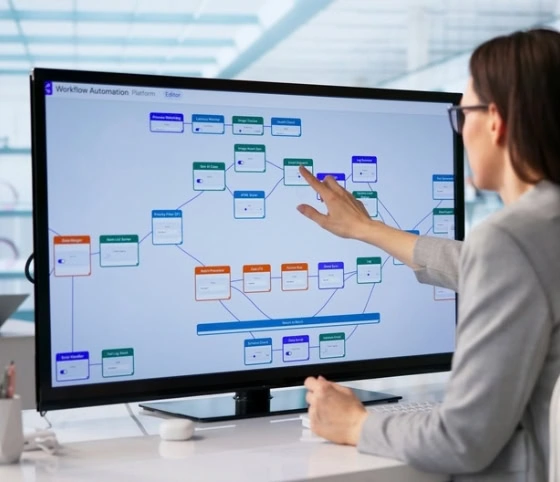
Automation services for business processes analyze, redesign, and automate repeatable workflows across people, rules, documents, data, and systems. They use orchestration, integrations, RPA, analytics, and governed AI where appropriate, while preserving approvals, exceptions, audit trails, security, service ownership, and measurable performance.
Signals that a workflow needs structured automation
- Teams repeat predictable steps across disconnected systems.
- Approvals stall without clear status or ownership.
- Manual handling creates errors, delays, and rework.
- Leaders lack reliable process performance evidence today.
Trusted by Businesses Worldwide
Saffron Tech helps businesses improve operational execution through workflow automation, process redesign, system integration, RPA, document intelligence, analytics, governed AI agents, automated testing, and continuous process support.
2.5K +
Success stories
150+
IT Professionals
30+
Industries Served
18+
Years of Experience
When Process Automation Fits
Automation fits stable, valuable workflows with clear inputs, outcomes, owners, and exception paths. Redesign may be required before technology can improve an inconsistent or unnecessary process.
| Situation | Recommended response | Decision to resolve |
|---|---|---|
| High-volume routine work | Automate repeatable validation, routing, entry, calculation, notification, and status updates | Confirm volume, stability, handling time, error cost, and exception rate |
| Cross-system workflow | Use APIs and orchestration to coordinate records, decisions, handoffs, and process state | Define system ownership, transaction boundaries, reconciliation, and failure recovery |
| Legacy interface gap | Use RPA when supported APIs are unavailable and the interface is sufficiently stable | Assess fragility, credentials, screen changes, support ownership, and replacement roadmap |
| Document-heavy process | Combine capture, classification, extraction, validation, workflow, and human review | Define document quality, confidence thresholds, sensitive data, and rejected-item handling |
| Judgment-heavy process | Use decision support or bounded AI while retaining responsible human authority | Separate recommendations, approvals, prohibited actions, overrides, and accountability |
| Unstable broken process | Standardize policy, ownership, data, and exception handling before automation | Remove unnecessary steps and confirm the future-state process first |
Our Business Process Automation Services
We combine process analysis, workflow design, integration, automation engineering, testing, governance, and operating support. Final scope follows business value, risk, system constraints, data, ownership, and change readiness.
Process Discovery and Automation Strategy
We map current workflows, variants, handoffs, delays, rework, systems, controls, and exceptions. The resulting roadmap ranks opportunities by value, feasibility, risk, dependency, and organizational readiness.
- Map current workflows and variants.
- Measure delays, rework, and volume.
- Score value, feasibility, and risk.
- Build a prioritized automation roadmap.
Workflow and Approval Automation
We automate routing, assignments, approvals, service deadlines, notifications, escalations, forms, records, and status visibility. Human decisions remain tied to defined authority, evidence, and the state of the process.
- Route work using governed rules.
- Capture approvals with decision evidence.
- Escalate overdue tasks to owners.
- Expose status across authorized teams.
System Integration and Data Automation
We connect CRM, ERP, HR, finance, service, content, analytics, and custom systems through suitable APIs, events, files, or middleware. Data ownership and reconciliation remain explicit.
- Connect systems through supported interfaces.
- Synchronize governed records and events.
- Validate mappings, states, and errors.
- Reconcile failures across connected systems.
RPA and Legacy Task Automation
We apply attended or unattended RPA to stable, rule-based tasks when direct integration is unavailable or uneconomical. Credentials, selectors, queues, retries, screenshots, and support responsibilities are controlled.
- Automate stable repetitive interface tasks.
- Separate attended and unattended execution.
- Secure credentials and runtime access.
- Monitor failures and interface changes.
Document and Communication Automation
We automate document intake, classification, extraction, validation, generation, distribution, and retention. Communication workflows can prepare, route, personalize, approve, and record messages across supported channels.
- Capture and classify incoming documents.
- Extract data with validation controls.
- Generate approved documents and messages.
- Route uncertain items for review.
AI Agent and Decision Support Automation
We design bounded AI assistants and agents for analysis, triage, retrieval, drafting, recommendation, and tool use. Permissions, data access, confidence, approvals, traces, fallback, and reversal are defined.
- Bound agents to approved actions.
- Require review for consequential decisions.
- Evaluate outputs against defined criteria.
- Record prompts, actions, and outcomes.
Automation Operations and Continuous Improvement
We monitor workflow health, queues, failures, service levels, dependencies, changes, and business outcomes. Support can include incident response, platform updates, optimization, documentation, and controlled expansion.
- Monitor executions, queues, and failures.
- Resolve incidents using process evidence.
- Update automations when systems change.
- Expand coverage through measured outcomes.
Prioritize the Right Automation Opportunities
A high manual workload does not automatically justify automation. Each candidate should be assessed against business value, process stability, exception complexity, data readiness, technical feasibility, and operational risk.
Business Value
Assess volume, handling time, backlog, delay and error costs, service impact, and growth constraints to determine whether automation can improve a measurable business outcome.
Process Stability
Review documented steps, policy consistency, process variants, changes, workarounds, and ownership to determine whether the process should be redesigned before automation.
Exception Profile
Analyze exception types, frequency, judgment requirements, escalation needs, evidence, and resolution time to determine which cases require human handling and which can be converted into rules.
Data Readiness
Evaluate source ownership, data quality, access, formats, sensitivity, retention, and reconciliation requirements to confirm that automation can safely use and update the required data.
Technical Fit
Review APIs, events, files, screens, platforms, authentication, environments, and change frequency to select an automation pattern that is reliable, supportable, and proportionate.
Operating Readiness
Confirm process ownership, support, monitoring, change management, training, budget, and accountability to establish who owns the outcome after implementation.
Design Human Decisions and Exception Paths
Automation must make responsibility clearer, not hide it. High-impact, ambiguous, sensitive, or policy-defined decisions need explicit human authority, evidence, escalation, and recovery paths.

Approval
Define who can approve, reject, delegate, or request additional evidence, with documented decisions, timestamps, supporting evidence, and escalation paths.

Exception
Classify expected exceptions and route them to accountable queues with defined service targets, owners, resolution statuses, and aging visibility.

Override
Restrict overrides to defined roles, reasons, and timeframes, while capturing the approver, changed values, expiry, and required follow-up review.

Fallback
Maintain a safe manual path for unavailable systems, failed automations, or uncertain outcomes, supported by runbooks, handoffs, duplicate prevention, reconciliation, and recovery testing.

Escalation
Trigger escalation based on severity, value, risk, delay, repeated failure, or policy conditions, with a defined owner, response target, action, and resolution record.

Accountability
Separate process ownership, platform administration, development, approval, security, and audit responsibilities through clear ownership, access boundaries, reviews, and decision rights.
Why Choose Saffron Tech for Business Process Automation
Saffron Tech combines process understanding, engineering expertise, and automation technologies to build solutions around how your business actually operates.
Automation Built Around Your Operations
Saffron Tech starts by reviewing existing workflows, identifying repetitive work, bottlenecks, and process gaps, then builds automation around actual operational needs rather than assumptions.
Integration Across Your Existing Systems
Connect CRM, ERP, databases, APIs, files, and other business applications to create smoother data flows and reduce manual movement of information between disconnected systems.
Multiple Automation Approaches
From workflow automation and RPA to data and reporting automation, Saffron Tech can apply different technologies depending on the process, technical environment, and business requirement.
Industry-Specific Expertise
Experience across 30+ industries, including healthcare, logistics, retail, e-learning, financial services, manufacturing, and telecommunications, supports automation tailored to different operational requirements.
Security and Compliance Built In
Saffron Tech highlights ISO 27001, HIPAA, GDPR, and SOC 2 Type II across its enterprise security and compliance capabilities, supporting projects that require structured security and data protection controls.
Continuous Optimization
Automation is treated as an ongoing improvement rather than a one-time implementation, with a focus on improving workflows, reducing manual effort, and adapting solutions as business needs change.

Plan Your Automation Initiative
Share the target process, current steps, participants, volume, systems, data, delays, errors, exceptions, controls, service goals, and existing evidence. We will define a discovery scope, opportunity score, future workflow, delivery pattern, pilot, business case, and operating plan.
Request a Process Automation AssessmentTechnologies Driving Business Process Automation
Our automation teams use workflow orchestration, APIs, RPA, document intelligence, analytics, cloud platforms, automated testing, observability, and governed AI agents to build secure, maintainable, and measurable business processes.



























AI & Data

Cloud & Platform Engineering
Engineering & Development
DevOps & Delivery
Digital Experience
Technology Consulting
Global Business Process Automation Expertise Across Industries
We provide full-cycle process automation for businesses managing customer operations, finance workflows, HR processes, enterprise services, document operations, approvals, data workflows, and cross-system business processes.








Enterprise-Grade Security & Compliance

ISO 27001

HIPAA Compliant

GDPR Complian

SOC 2 Type II
Case Studies
Before this, managing our ML workflows took a lot of manual effort. The automation has made things much easier for our engineering teams.

Rohan Mehta
Head of AI EngineeringWe had data across too many systems and it was slowing down decisions. The AI platform helped us bring everything together and made day-to-day operations much smoother.”

Dr. Michael Carter
Chief Technology OfficerForecasting used to take a lot of manual work. With AI handling the analysis now, our team can focus more on strategy and customer experience.

Alex Romero
VP Engineering“The biggest difference for us is visibility. We can now see potential issues before they affect production.”

Daniel Hughes
Chief Information Officer“Routing decisions used to take hours of planning. Now the system helps us make those decisions much faster.”

Sophia Lang
Head of Data & Technology“The AI monitoring tools help us spot problems early. It’s made managing the network much easier for our team.”

Kevin Patel
Chief Technology OfficerWhat Our Clients Say
Saffron Edge is an amazing and highly recommended SEO company. They are always responsive, professional, and best of all they show RESULTS! HIGHLY RECOMMENDED!

Salvabor Ordorica
Operations Manager, Translation CompanyThe quality is exceptional. I love their work, and I appreciate our back-and-forth.

Xanare
President, Flexyn GlobalI felt that they really understood my vision and were really excited about it.

Caitlin Thorpe
Founder, Seamless TherapyBusiness Process Automation FAQs
These answers address process selection, RPA, integrations, human approval, exceptions, security, ownership, business cases, maintenance, and AI questions buyers commonly raise during automation planning.
Which processes should we automate first?


What is the difference between BPA and RPA?
Should we automate a process before redesigning it?
How do APIs and RPA work together?
How are automation exceptions handled?
How is automated access secured?
Who owns an automated business process?
How do we calculate automation ROI?
What happens when connected systems change?
How will automation change through 2028?
Find out what Saffron Tech can do for you
- Free assessment and roadmap
- Custom solution recommendations
- ROI projections for your use case
Reach out to us
Reach out to us