


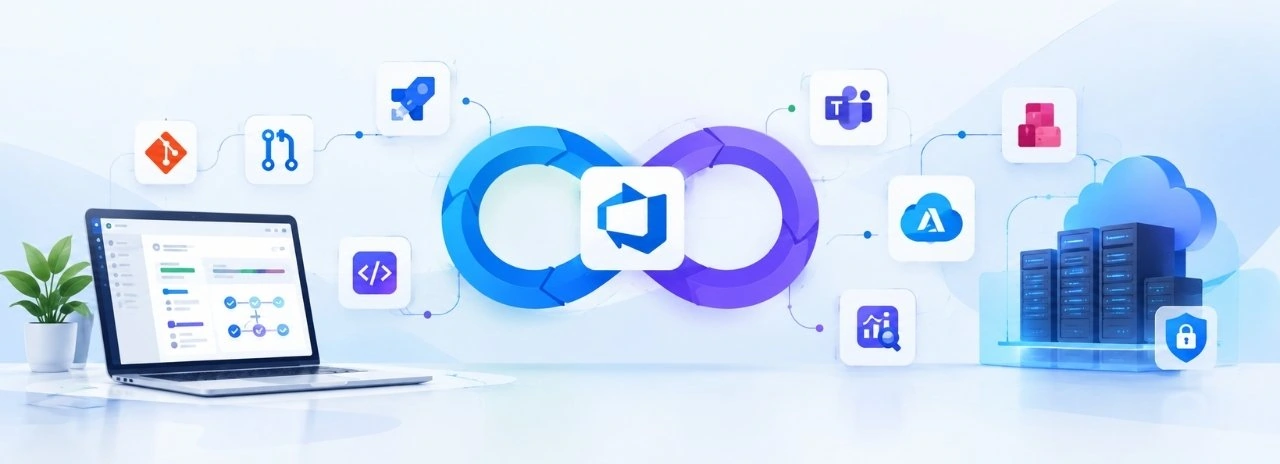


Build Faster. Release With Confidence.
Reduce overall release effort. Give your team clear control over code, deployments, and application health.

Delivery Speed: Minimize manual handoffs

Environment Consistency: Streamline infrastructure management

Code Collaboration: Set clear requirements

Code Review: Set clear requirements

Release Control: Define testing and approvals

Continuous Improvement: Use delivery data.

What Is an Azure DevOps Solution?
An Azure DevOps solution combines Microsoft’s development tools with the workflows, infrastructure, and controls needed to deliver software. Azure DevOps Services provides cloud-hosted tools. Azure DevOps Server supports self-hosted environments.
Why Do Companies Need Azure DevOps Solutions as a Service?
- Reduce manual release work with automated builds, testing, and deployments.
- Keep teams aligned through shared code reviews, work tracking, and release controls.
- Access specialist support for infrastructure, pipelines, and delivery improvements.
Trusted by Businesses Worldwide
Saffron Tech builds Azure DevOps solutions that connect your existing tools, automate software delivery, and give teams clearer control over releases and application performance.
2.5K +
Success stories
150+
IT Professionals
30+
Industries Served
18+
Years of Experience
Our Azure DevOps Services
Address the delivery problem first. Configure the tools, workflows, and controls around your applications and operating requirements.
Azure DevOps Consulting
Identify what slows delivery and where automation will provide the most value. Turn current workflows, technical constraints, and release risks into a prioritized implementation plan.
- Delivery workflow and toolchain assessment
- Repository, pipeline, and environment architecture
- Governance requirements and ownership mapping
- Implementation roadmap and measurement baseline
Infrastructure & Configuration Management
Make infrastructure changes repeatable and easier to review. Define provisioning and configuration workflows that reduce manual setup and make environment differences visible.
- Infrastructure as code architecture
- Versioned templates and environment parameters
- Configuration validation and drift review
- Infrastructure change approvals and deployment procedures
Source Code Management & Integration
Give teams a clear path from code contribution to approved change. Organize repositories and review policies around application ownership and release needs.
- Repository structure and access permissions
- Branching strategy and pull request workflows
- Build validation and reviewer requirements
- Connections between code changes and work items
CI/CD & Deployment Automation
Reduce manual release work with pipelines that build, validate, and deploy approved changes. Keep deployment logic versioned and define how releases move across environments.
- YAML pipeline design and reusable templates
- Build, test, and deployment stages
- Artifact versioning and promotion
- Environment checks and production approvals
Application Testing & Release Management
Catch defects before they reach production and make release readiness visible. Connect automated checks with manual acceptance testing where human review is needed.
- Unit, integration, and smoke test execution
- Test results and agreed quality thresholds
- Acceptance testing and release readiness checks
- Release records and recovery procedures
Azure DevOps Migration
Move delivery workflows with a clear cutover plan. Assess what can transfer, what needs rebuilding, and which dependencies could affect ongoing development.
- Repository, pipeline, and work item inventory
- Migration approach and compatibility review
- Permissions and integration reconfiguration
- Pilot migration, validation, and cutover planning
Monitoring & Performance Management
Connect deployment activity with application behavior. Give teams the telemetry needed to investigate failures and prioritize performance improvements.
- Application and infrastructure telemetry integration
- Performance dashboards and health indicators
- Alert thresholds and response ownership
- Post-release analysis and optimization backlog
When Should You Invest in Azure DevOps?
Focus investment where delivery friction creates delays, recurring failures, or unnecessary operating effort.
When Manual Deployments Slow Delivery
Replace repeated deployment tasks with defined pipeline steps. Reduce dependence on individual team members remembering commands, settings, and release sequences.
When Environments Become Difficult to Maintain
Bring infrastructure definitions and configuration changes under version control. Make differences between development, testing, and production intentional and reviewable.
When Teams Work Across Disconnected Tools
Connect repositories, work tracking, testing, and release activity. Reduce time spent reconstructing status across separate systems.
When Releases Cause Recurring Issues
Introduce earlier validation and explicit release criteria. Use deployment evidence to identify whether failures originate in code, configuration, infrastructure, or release procedures.
When Migrating or Scaling Your Applications
Review delivery architecture before adding workloads or teams. Plan agent capacity, permissions, dependencies, and deployment targets around the environment you need to support.
Build Security and Control Into Delivery
Define who can change code, access credentials, and authorize deployments. Keep permissions and release controls aligned with workload risk.

Identity and Access Management
Assign role-based access to repositories, pipelines, and deployment resources. Restrict service connections to the resources and permissions required by each workload.

Secrets Management
Keep credentials and tokens out of source code and pipeline definitions. Define approved storage, access, rotation, and logging practices for sensitive values.

Configuration Management
Separate environment-specific settings from application code. Version configuration files where appropriate and restrict access to sensitive configuration values.

Code Reviews and Branch Policies
Require pull request reviews and build validation according to repository policies. Restrict policy bypass permissions and document approved exceptions.

Deployment Approvals and Environment Controls
Configure approvals and checks on deployment resources. Keep authorization controls separate from pipeline YAML to govern access to protected environments.

Rollback and Recovery Planning
Define rollback or roll-forward procedures based on application behavior and data dependencies. Establish recovery triggers and validate procedures before production incidents.
Get Deliverables Your Team Can Use
Make the implemented workflow understandable and maintainable. Agree on the handover package during scoping.
DevOps Assessment and Implementation Roadmap
A prioritized plan that connects delivery problems with proposed changes. Include dependencies, ownership, and acceptance criteria.
Infrastructure Templates and Configuration Documentation
Versioned infrastructure definitions and environment settings for the agreed scope. Document parameters, prerequisites, and change procedures.
Repository Structure and Integration Workflows
Documented repository ownership, branching rules, review requirements, and integration triggers. Give contributors a clear process for submitting and validating changes.
CI/CD Pipelines and Release Procedures
Pipeline definitions, artifact handling, and environment progression rules. Include approval steps, deployment checks, and recovery instructions.
Monitoring Dashboards and Operational Runbooks
Dashboards are tied to agreed health indicators and delivery metrics. Runbooks explain alert ownership, investigation steps, and escalation routes.
Team Handover and Agreed Support Coverage
Walkthroughs and documentation for the implemented solution. Define ongoing support, maintenance responsibilities, and optimization coverage in the engagement.

Cut Release Delays. Keep Delivery Moving.
Reduce manual deployment work and make release readiness clear. Connect code, testing, and infrastructure through delivery workflows built around your applications.
Talk to our Azure DevOps ExpertsWhat Does Azure DevOps Include?
Select the components that address your delivery requirements.
| Azure Boards | Work planning, backlogs, and issue tracking. Organize priorities, assign ownership, and track progress so teams know what needs attention and what is ready for delivery. |
| Azure Repos | Source control, pull requests, and code reviews. Keep code changes under version control and use branch policies to require reviews and validation before merging. |
| Azure Pipelines | Automated builds, tests, and deployments. Turn code changes into repeatable delivery workflows, with defined stages and checks for each environment. |
| Azure Test Plans | Manual and exploratory test management. Organize test cases, record results, and link defects to development work so teams can assess release readiness. |
| Azure Artifacts | Package hosting, versioning, and sharing. Store reusable dependencies in managed feeds so teams can access approved package versions across projects. |
Why Choose Saffron Tech for Azure DevOps?
Build the engagement around delivery goals, operating constraints, and the team that will maintain the solution.
Implementation Aligned With Your Delivery Goals
Prioritize the work that addresses your biggest bottlenecks. Set measurable acceptance criteria around release effort, validation, and operational visibility.
Integration With Your Existing Systems
Assess your repositories, testing tools, infrastructure, and deployment targets before recommending changes. Define where to retain, connect, or replace existing components.
Maintainable Infrastructure and Pipelines
Keep delivery logic versioned and documented. Use reusable components where they simplify maintenance without hiding application-specific requirements.
Clear Release Controls
Make approval ownership and release conditions explicit. Match controls to workload risk so teams understand what must happen before production deployment.
Practical Documentation and Knowledge Transfer
Give your team the context needed to operate the implementation. Explain configuration decisions, routine changes, and failure recovery procedures.
Defined Optimization and Support Scope
Agree on what happens after implementation. Establish ownership for monitoring, pipeline maintenance, incident response, and future improvements.
Technologies Driving Azure DevOps Solutions
We connect source control, infrastructure automation, testing tools, and monitoring to build repeatable delivery workflows. Your team gains clearer release controls, consistent environments, and visibility into application performance.




























AI & Data

Cloud & Platform Engineering
Engineering & Development
DevOps & Delivery
Digital Experience
Technology Consulting
Global Expertise Across Every Industry
We tailor Azure DevOps solutions to your industry’s applications, operating requirements, and release constraints. Automated workflows help teams reduce delivery friction, maintain traceable approvals, and adapt as workloads grow.








Enterprise-Grade Security & Compliance

ISO 27001

HIPAA Compliant

GDPR Complian
SOC 2 Type II
Case Studies
Before this, managing our ML workflows took a lot of manual effort. The automation has made things much easier for our engineering teams.

Rohan Mehta
Head of AI EngineeringWe had data across too many systems and it was slowing down decisions. The AI platform helped us bring everything together and made day-to-day operations much smoother.”

Dr. Michael Carter
Chief Technology OfficerForecasting used to take a lot of manual work. With AI handling the analysis now, our team can focus more on strategy and customer experience.

Alex Romero
VP Engineering“The biggest difference for us is visibility. We can now see potential issues before they affect production.”

Daniel Hughes
Chief Information Officer“Routing decisions used to take hours of planning. Now the system helps us make those decisions much faster.”

Sophia Lang
Head of Data & Technology“The AI monitoring tools help us spot problems early. It’s made managing the network much easier for our team.”

Kevin Patel
Chief Technology OfficerWhat Our Clients Say
Saffron Edge is an amazing and highly recommended SEO company. They are always responsive, professional, and best of all they show RESULTS! HIGHLY RECOMMENDED!

Salvabor Ordorica
Operations Manager, Translation CompanyThe quality is exceptional. I love their work, and I appreciate our back-and-forth.

Xanare
President, Flexyn GlobalI felt that they really understood my vision and were really excited about it.

Caitlin Thorpe
Founder, Seamless TherapyFAQs
What Do Azure DevOps Services Include?


Can Azure DevOps Integrate With Our Existing Tools?
Can Azure DevOps Support Applications Outside Azure?
How Do You Approach an Azure DevOps Migration?
What Determines Implementation Time and Cost?
What Support Is Available After Implementation?
Find out what Saffron Tech can do for you
- Free assessment and roadmap
- Custom solution recommendations
- ROI projections for your use case
Reach out to us
Reach out to us